Industries · Healthcare
The right answer, at the right moment.
Clinical and administrative staff navigate dozens of systems every day, and so do patients. When someone is unwell, confused, or in pain, being able to ask a question in plain English and get a clear, immediate answer isn't a convenience. It's critical.
The reality
Vast knowledge. Zero margin for error.
Trusts and providers manage enormous, fast-changing knowledge environments (clinical guidance, referral pathways, policies, service pages) under hard governance constraints. Generic AI fails here precisely because the stakes are real: an unguarded answer isn't a bug, it's a safety incident. What healthcare needs is AI with the boundaries engineered in.
“We want patients to search our site in plain English and get accurate, verified answers.”
- Scope controls: to avoid classification as a medical device
- Guardrails: against hallucination, for policy compliance
- Content ingestion: from the CMS, kept continuously in sync
- Traceability: every answer linked back to its sources
- Resilience: against model outages, rate limits, API changes
The platform, applied
How Nous AI works in healthcare.
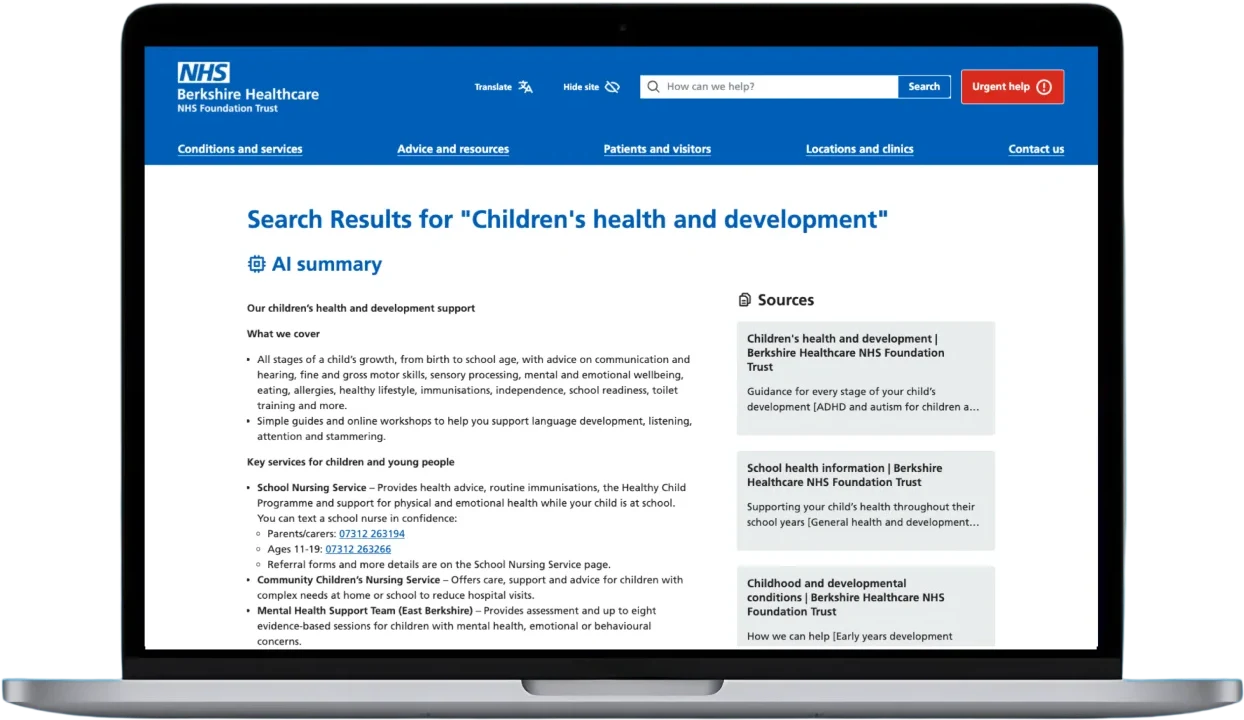
One place to ask anything in plain English (referral pathways, service information, policies) with sources alongside every answer and the medical-advice boundary enforced by scope controls.
Document-heavy administrative work (correspondence, reporting, structured data entry) taken end-to-end with human review built into every step that touches care.
Incoming documents classified, extracted and routed into your systems of record, with field-level confidence and a full audit trail behind every value.
Every assistant rehearsed against the awkward cases before launch, and decision reasoning logged at every step, ready for your information-governance team.
Watch it work
Helpful to everyone. Safe by design.
The same assistant answers a staff pathway question from current guidance, and when a patient asks it to make a clinical decision, stops at the medical-advice line and points to a person. The boundary isn't a filter bolted on; it's engineered in.
Proven in the field
Case · Live deployment
Grounded Answers. Powered by Nous AI.
Patients ask in plain English and receive grounded, verifiable answers, with built-in scope controls and guardrails.